
Vanguard News Group - - Tom Steyer Brings Campaign Stop to Tres Hermanas in Davis
By: David Greenwald

DAVIS, Calif. — Gubernatorial candidate Tom Steyer made a campaign stop in Davis on Friday, meeting with UC Davis students and local Democrats at Tres Hermanas while hitting on his points on affordability, housing, health care and youth political engagement as central themes of his campaign.
Steyer told the gathered students that young people have long been underrepresented in politics despite historically serving as catalysts for social and political change.
“Let me say I am very excited to be here at UC Davis,” Steyer said. “You should know that I organized a group of people to register a million Californians between the ages of 18 to 30 in 2016 because I felt as if young people’s voices weren’t being heard and their votes were way lower than their numbers and therefore their impact politically was much lower than it should be.”
Steyer argued that elected officials primarily respond to voters and that increasing youth turnout remains essential for political influence.
“When politicians care about votes, that is the thing they care about,” Steyer said. “And unless you vote, you basically are a silent person in their opinion.”
He added that students have historically played an important role in advancing new ideas.
“I was just saying traditionally young people, particularly students have led changes and thoughts, new ideas, new recognitions of truth,” Steyer said. “And that’s still true.”
The event came as Steyer continues to center his gubernatorial campaign around concerns about affordability in California, particularly for younger residents facing high housing costs, educational expenses and economic uncertainty.
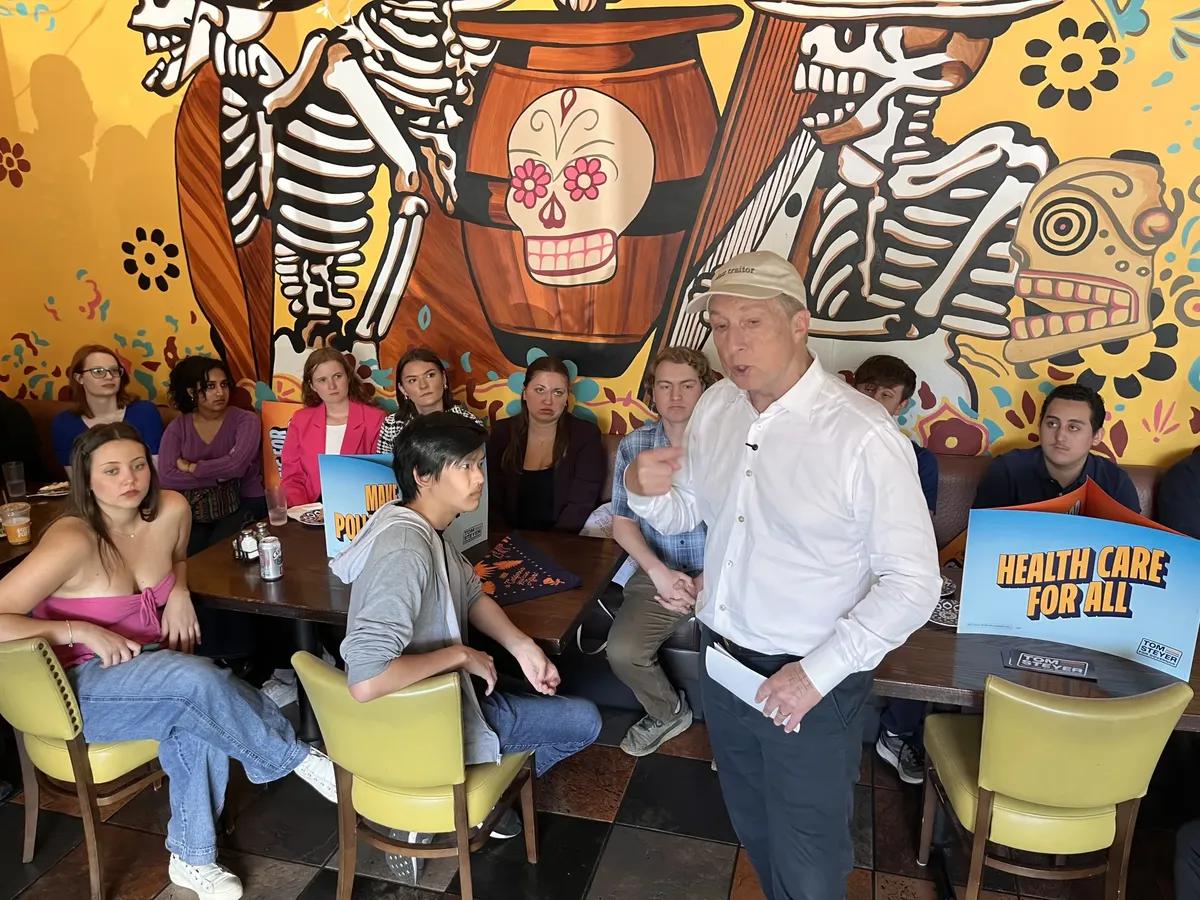
“As the father of four kids, and my kids are not kids, they’re full adults, but I know that there is a huge generation of this in California,” Steyer said. “I know that young people feel as if the system has not been built or has not stopped working to support them.”
According to Steyer, those concerns extend across multiple aspects of daily life.
“It goes to the ability to find jobs. It goes to housing costs, the ability to afford to live in California in the most basic of ways, the cost of education itself,” he said.
During the event, Steyer characterized the gubernatorial contest as a choice between competing visions for California and repeatedly returned to affordability as his central issue.
“The fact that California is unaffordable for Californians and how to actually bring down costs so people can have healthcare, have housing, pay for electric and gas bills and have a great education,” Steyer said. “That is what I stand for.”
Steyer also criticized what he described as the influence of major corporations and special interests in state politics.
“In every one of those there are organized special interests, corporations who are making record profits by making everyone’s prices really high,” he said. “And they’re listening to what I’m saying and they’re taking it seriously and they’re spending tens of millions of dollars to make sure that I don’t win.”
Throughout his remarks, Steyer noted support he has received from labor organizations and worker groups.
“It’s the teachers, the nurses, the people, home care workers, childcare workers, the people who work in restaurants and hotels, the carpenters,” Steyer said. “Those guys are all for me.”
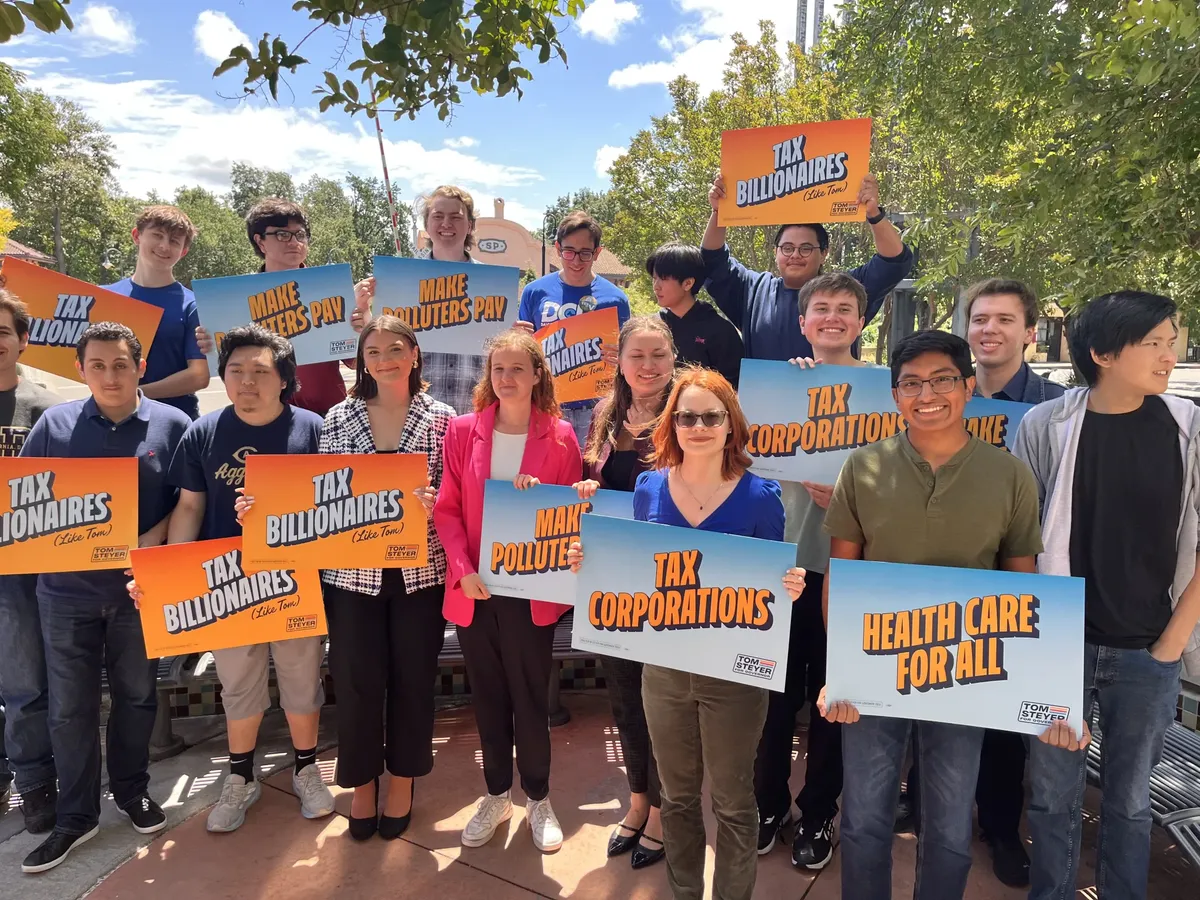
He described the campaign as a broader struggle between working people and corporate interests.
“When I say it’s working people against the corporations, that’s actually if you look at officially who’s taking a claim on this race, who’s putting in money and who’s standing up,” he said.
Steyer repeatedly returned to the idea of restoring what he called the California Dream.
“I also want to say my whole campaign is about restoring California,” Steyer said. “California can get a good job, actually buy a house and get great free education in the world.”
He contrasted California’s economic strength with persistent inequality and poverty.
“This is the richest state in the world,” Steyer said. “We are creating wealth at a level that is historically unimaginable. We have the highest poverty rate in the United States. We have the highest inequality in the United States.”
Steyer also highlighted his personal background, including his family’s history of public service.
“My mom’s a teacher,” he said. “She worked in some very disadvantaged public schools.”
He added that his father served in the Navy and later worked as a prosecutor after World War II.
“My dad was in the Navy and because he was a lawyer, he was one of the prosecutors of Nazis after the war,” Steyer said.
Steyer said his own career shift away from business was motivated by a desire to continue that tradition.
“I’m weird because I walked away from it 14 years ago to do what my family traditionally does — to just give back and try to make a positive impact on society,” he said.
In addition to affordability, Steyer pointed to democracy and climate change as major challenges facing California and the nation.
“We have a gigantic democracy crisis because Donald Trump wants to end our democracy,” Steyer said.
He also warned about the effects of rising global temperatures.
“The next 18 months are supposed to be hotter than at any time of human beings on Earth by a block,” Steyer said.
“We cannot have a governor of California who does not understand that,” he added.
Before speaking to the larger group, Steyer briefly spoke with the Vanguard about his visit to Davis and his interest in hearing directly from students.
Asked what brought him to the city, Steyer said, “Well, there are kids from UC Davis in the Democratic Club who I was going to go have lunch with and hear what they’re up to and talk a little bit about the campaign, but mostly listen.”
When asked what message he hoped to convey, Steyer focused on listening and optimism.
“Well, I want to hear what their issues are and what their concerns are and what their hopes are,” he said. “And I want to convey to them that they can live the California dream and that we’re going to get this state to work for them again.”
Asked whether he remained optimistic about California’s future, Steyer responded enthusiastically.
“Hell yeah, totally,” he said. “But I want them to know why. It’s one thing to be blindly optimistic. There’s another way to have a plan to be optimistic about, and that’s what I am.”
Addressing Davis specifically, Steyer pointed to issues that resonate strongly in university communities.
“I think, look, we’re talking about how to keep housing prices down,” he said. “We’re talking about how to get single payer healthcare. We’re talking about electricity and gas prices coming down, but we’re also talking about great education.”
He also praised communities built around major universities.
“My experience of the towns around great schools, great universities, some of the greatest places to live in the world, every single time,” Steyer said. “And that’s true in California too.”